Kimi K3 Benchmark Breakdown: How Moonshot's 2.8T Model Stacks Up Against Fable 5, GPT-5.6, and GLM-5.2
Moonshot AI's Kimi K3 just landed at #3 on Artificial Analysis and #1 on Arena's frontend coding leaderboard. We break down every major benchmark, compare it head-to-head with Fable 5, GPT-5.6 Sol, and GLM-5.2, and explain why the model race is only half the story.
On July 16, 2026, Moonshot AI released Kimi K3 — a 2.8 trillion-parameter, open-weight model with a 1 million-token context window, native vision, and an "always-on reasoning" mode. Within 24 hours it climbed to #1 on Arena's frontend coding leaderboard, #3 on Artificial Analysis's Intelligence Index, and set off a wave of reactions across X that tech analyst Patrick Moorhead compared to the "DeepSeek moment" of 2025.
This article is a fact-based breakdown of every major benchmark we could verify, a head-to-head comparison with the three models most likely sitting next to K3 in your evaluation spreadsheet — Anthropic's Claude Fable 5, OpenAI's GPT-5.6 Sol, and Zhipu AI's GLM-5.2 — and a closing argument for why the model layer, no matter how good, is only half the equation.
The benchmarks, model by model
Artificial Analysis Intelligence Index
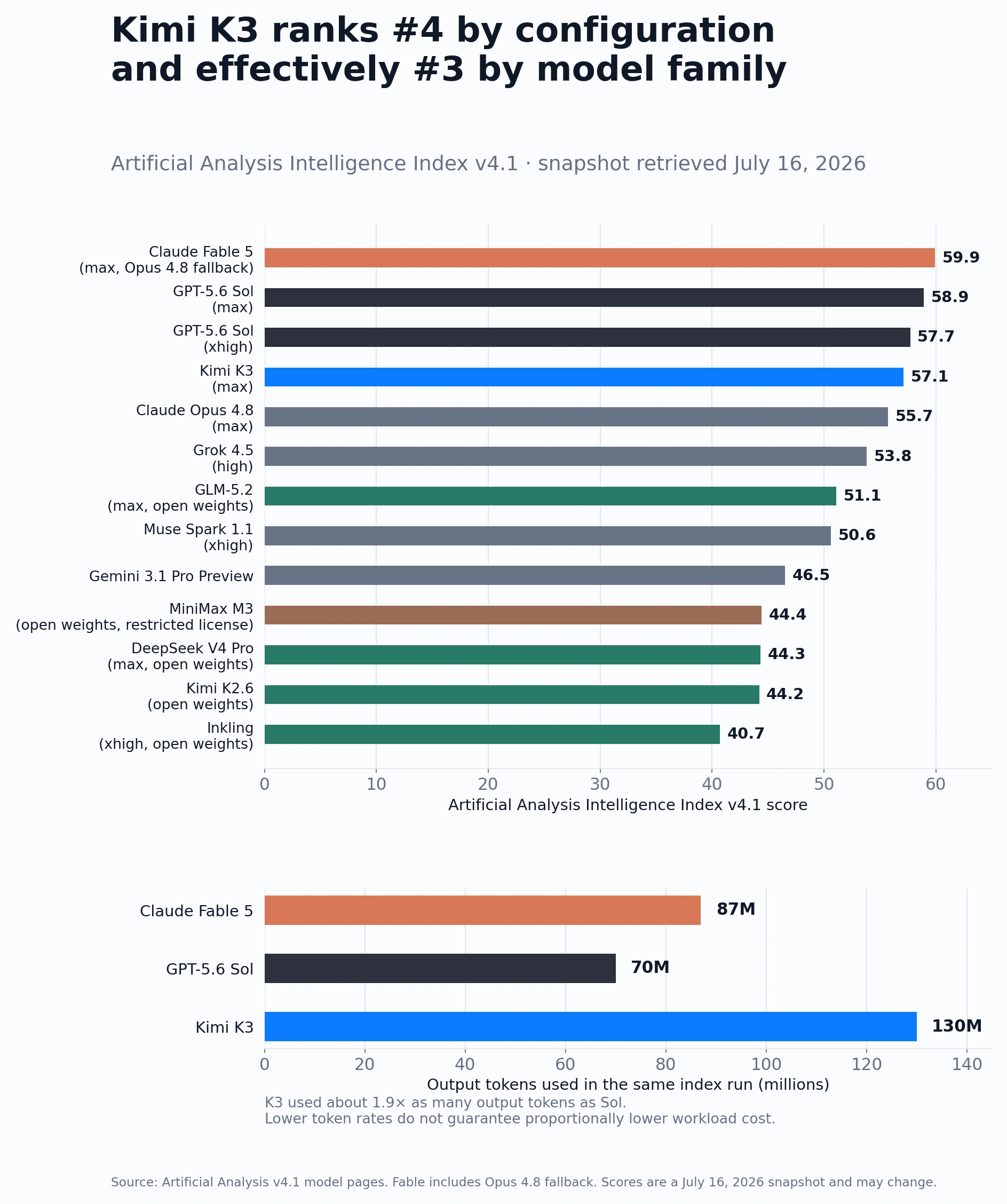
This composite index combines nine evaluations (GDPval-AA v2, Terminal-Bench 2.1, SciCode, Humanity's Last Exam, GPQA Diamond, and long-context reasoning) to produce a single intelligence score across 189 models.
| Model | Intelligence Index | Percentile |
|---|---|---|
| Claude Fable 5 (max) | 60 | 98% |
| GPT-5.6 Sol (max) | 59 | 98% |
| Kimi K3 | 57.1 | 97% |
| Claude Opus 4.8 | ~57 | 97% |
| GPT-5.5 | ~55 | 96% |
| GLM-5.2 | not yet published | — |
Takeaway: K3 enters the frontier tier but doesn't dethrone Fable 5 or GPT-5.6 Sol on this broad index. The gap between third and first is roughly 3 points — tight by historical standards.
Arena Leaderboards (Blind ELO)
Arena's blind comparison model is the closest thing to a "vibes" benchmark — real users pick winners without knowing which model they're testing.
| Arena | #1 | K3 score |
|---|---|---|
| Text Arena | Fable 5 | K3 competitive |
| Code Arena | Fable 5 | K3 competitive |
| Agent Arena | Fable 5 | K3 competitive |
| Frontend Web Dev | Kimi K3 — 1,679 | Fable 5: 1,631 · GPT-5.6 Sol: 1,618 |
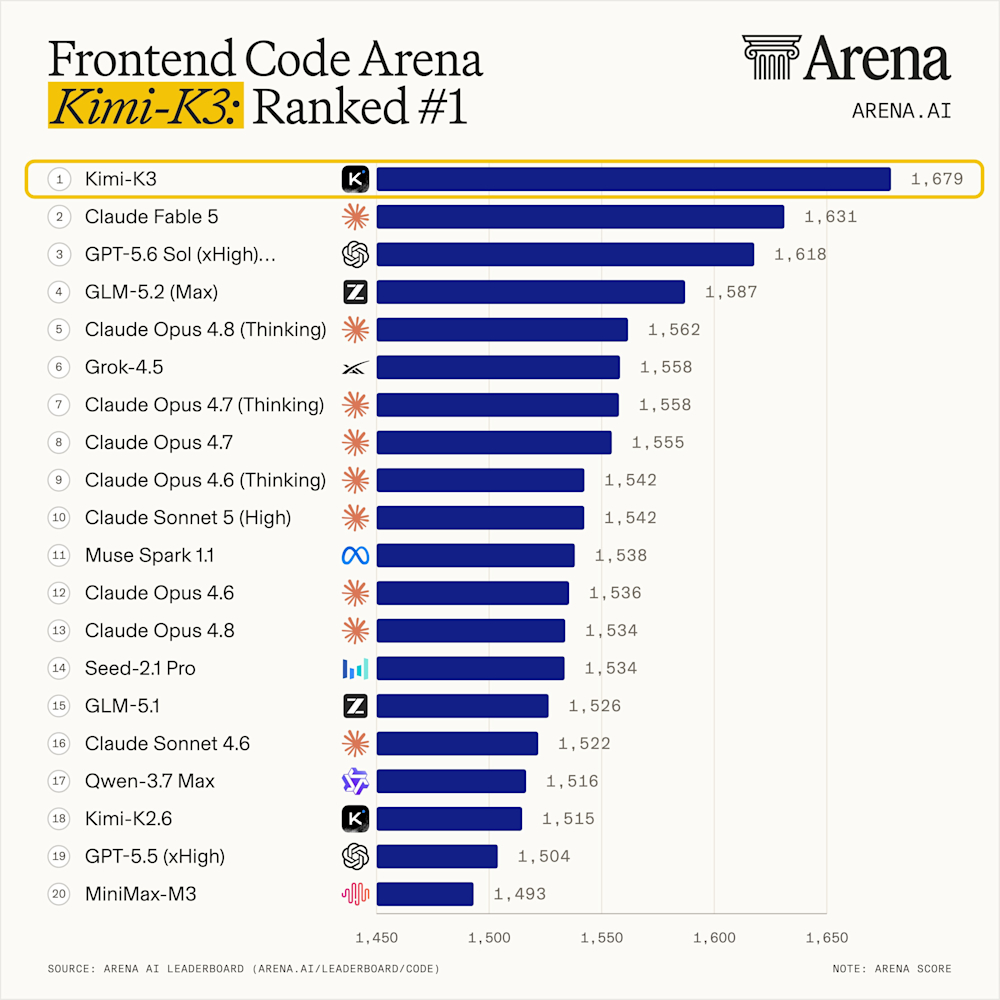
K3 took #1 in six of seven frontend coding subcategories, only placing second in the game category. Its predecessor Kimi K2.6 sat at #18 with 1,515 points — a 164-point jump in one generation.
Arena co-founder Anastasios Angelopoulos called K3 "the single biggest release of the year" and the moment "open-source Chinese models are surpassing closed U.S. models."
Coding & Software Engineering
This is where K3 makes its strongest case.
| Benchmark | Kimi K3 | Fable 5 | GPT-5.6 Sol | GLM-5.2 |
|---|---|---|---|---|
| SWE-bench Verified | 60.4% | 95.0% | — | ~77.8%* |
| DeepSWE | 67.5% | — | top | 46.2% |
| Terminal-Bench 2.1 | 88.3% | 88.0% | 88.8% (Sol) / 91.9% (Ultra) | — |
| ProgramBench | 77.8% (1st) | — | 77.6% | — |
| SWE Marathon | 42.0% (1st) | — | 39.0% | — |
| FrontierCode Diamond | — | 29.3% | 5.7% | — |
GLM-5.2 score inherited from GLM-5.1 predecessor; independent GLM-5.2 evaluation pending.
K3 leads in sustained coding tasks (SWE Marathon, ProgramBench) and matches the frontier on Terminal-Bench. Fable 5 still dominates on SWE-bench Verified (95.0% vs 60.4%) and hard coding problems (FrontierCode Diamond).
Knowledge Work & Reasoning
| Benchmark | Kimi K3 | Fable 5 | GPT-5.6 Sol |
|---|---|---|---|
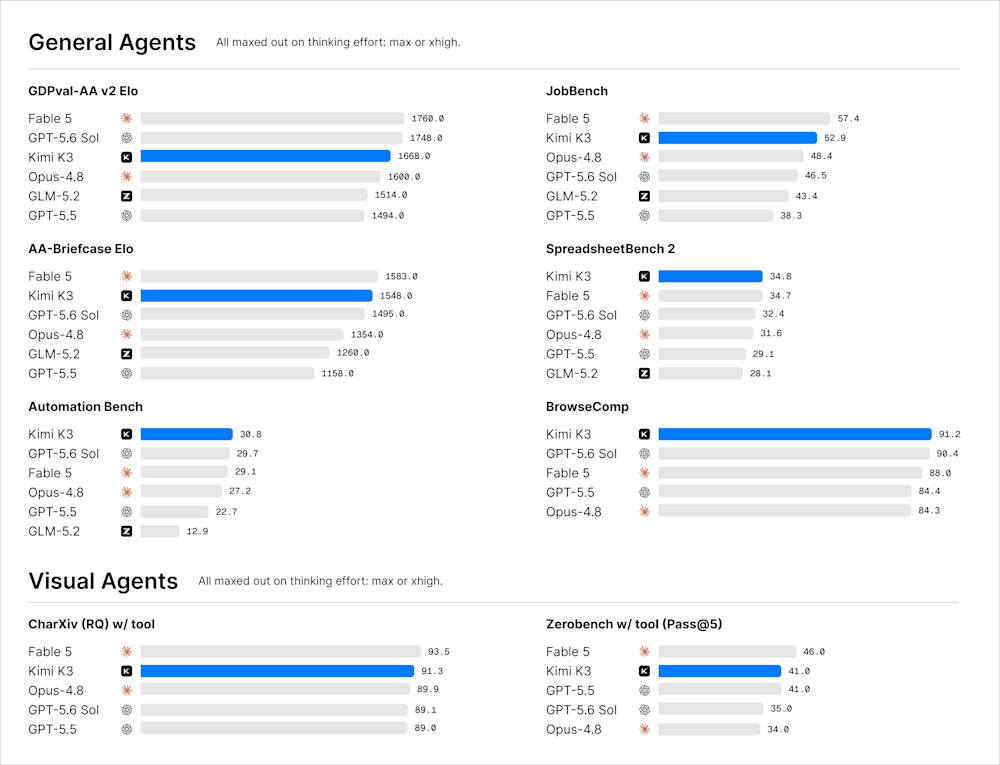
| BrowseComp | 91.2 | — | 92.2 |
| GPQA Diamond | 93.5% | — | — |
| Humanity's Last Exam | 44.3% | 59.0% (no tools) / 64.5% (with tools) | — |
| Agents' Last Exam | — | ~40 | 53.6 |
| GDPval-AA v2 | 1,687 (3rd) | top | top |
GPT-5.6 Sol narrowly edges K3 on BrowseComp (92.2 vs 91.2). K3's GPQA Diamond score of 93.5% is strong — graduate-level scientific reasoning. Fable 5 leads on Humanity's Last Exam.
Agentic Tasks
| Benchmark | Kimi K3 | Fable 5 | GPT-5.6 Sol |
|---|---|---|---|
| AutomationBench | ranked 1st (4/8 benchmarks) | 17.4% | — |
| OSWorld 2.0 | — | — | 62.6% |
| SpreadsheetBench 2 | ranked 1st | — | — |
K3 claims first in four out of eight real-world automation benchmarks. GPT-5.6 Sol dominates computer-use tasks (OSWorld). Fable 5 leads on AutomationBench's precision metric.
Vision
K3 has native multimodal capabilities — images and video processed natively, no OCR pipeline.
| Benchmark | Kimi K3 | Fable 5 | GPT-5.6 Sol |
|---|---|---|---|
| GDP.pdf (Knowledge-work vision) | — | 29.8% | 24.9% |
| Object Detection (mAP@50) | — | — | 46.2 |
Vision evaluations for K3 are still emerging. What we do know: K3's 1M-token context window processed images and video in BrowseComp without context compression, which is architecturally distinctive.
What the experts are saying
The reaction on X has been split between genuine respect and calibrated skepticism:
Bullish:
- Aaron Levie (CEO, Box): Called K3 a "huge win" for companies building on AI — cheaper frontier intelligence expands enterprise use cases.
- Gavin Baker (investor): Deemed K3 an "inflection point" — increased competition lowers margins at the model layer, benefiting everyone except closed AI startups.
- Anastasios Angelopoulos (co-founder, Arena): "May be the single biggest release of the year."
- Theo Browne (developer/YouTuber): Titled his hands-on review "Kimi K3 is the best model ever made (sometimes)." 3D/visual coding — most capable he's seen in open-weight.
- "World of AI" (YouTube): Called K3 "insane" for consistent top-tier coding quality and noted it's "much cheaper than Fable 5."
Cautious:
- David Sacks (PCAST co-chair): Expressed "concern" over K3's frontend-coding lead, warning that US self-imposed limitations could cost the AI race.
- Ethan Mollick (Wharton professor): Urged caution — K3 "messed up" complex statistical audits in his testing.
- Patrick Moorhead (tech analyst): Compared the reaction to an "overreaction shockingly similar" to the DeepSeek moment.
- Daniel Jeffries: Acknowledged K3's strength but satirized the predictable hype cycle of "grandstanding, posturing, and talking-headery."
- Theo Browne (developer/YouTuber): Posted a pointed cost analysis: "Kimi K3 is an incredible model. It is not an incredible value. K3 is half the price of 5.6 Sol per token. GPT-5.6 uses half as many tokens. Price evens out. GPT-5.6 is 2x faster TPS, so it gets work done ~4x faster than K3 at roughly the same price." (source)
Pricing: K3's real disruption
The benchmark story is competitive. The per-token pricing looks disruptive — until you look at actual task costs.
| Model | Input (per 1M tokens) | Output (per 1M tokens) | Context Window |
|---|---|---|---|
| Kimi K3 | $3.00 ($0.30 cached) | $15.00 | 1M |
| GPT-5.6 Sol | $5.00 | $30.00 | 1.05M |
| Claude Fable 5 | $10.00 | $50.00 | 1M+ |
| GLM-5.2 | ~$1.00 | ~$5.00 | 1M |
K3's per-token rates look like 30% of Fable 5's price. But here's the catch that Theo Browne flagged in a widely-shared post:
The per-token illusion
K3 is extremely verbose. During Artificial Analysis's Intelligence Index evaluation, K3 generated 130 million output tokens — compared to 70M for GPT-5.6 Sol and 87M for Fable 5. That's roughly 1.9x more output tokens than Sol for the same set of tasks.
Do the math:
- K3: $15/M output × 130M tokens = ~$1,950 in output cost
- GPT-5.6 Sol: $30/M output × 70M tokens = ~$2,100 in output cost
- Fable 5: $50/M output × 87M tokens = ~$4,350 in output cost
K3 is genuinely cheaper than Fable 5, but compared to GPT-5.6 Sol, the total task cost is nearly identical — K3's token price advantage is canceled out by its higher token consumption.
Speed compounds the gap
K3 processes about 62 tokens per second. GPT-5.6 Sol runs at roughly 2x that speed. Combined with the higher token count, Sol completes the same work approximately 4x faster than K3 at similar cost.
As Theo put it: "I still love K3 and will be using it for a TON of stuff. I'm just tired of people pretending it's way cheaper when it's not."
When K3's pricing does win GLM-5.2 remains the cheapest option for teams willing to accept a benchmark tier below the frontier.
The cached input pricing ($0.30/M) is where K3 genuinely shines — for workloads with stable prompts and reused repository prefixes, the effective input cost drops 90%. Moonshot reports a cache-hit rate above 90% on coding workloads. For long-context tasks with high cache reuse, K3 can be materially cheaper than anything else at this performance level.
The pricing gets even more interesting with cached input: $0.30 per million tokens means long-context workflows — code reviews over large repositories, document analysis across 100K+ pages — become economically viable at scale.
Moonshot plans to release full model weights by July 27 under a Modified MIT license. At that point, self-hosting eliminates the API cost entirely.
So which model should you choose?
It depends on what you need:
- Hardest coding problems (FrontierCode Diamond, SWE-bench Verified): Fable 5 still leads by a wide margin.
- Terminal/agentic tasks (Terminal-Bench, command-line workflows): GPT-5.6 Sol Ultra edges everyone at 91.9%.
- Frontend development and UI coding: K3 is the clear winner — #1 on Arena's frontend leaderboard.
- Long-running sustained tasks (SWE Marathon, BrowseComp): K3 leads or ties.
- Cost-sensitive production: K3 at $3/$15, especially with $0.30 cached inputs. GLM-5.2 if you need even cheaper.
- Open-weight self-hosting: K3 after July 27 weights release. GLM-5.2 available now under MIT.
But here's the thing — the model is only half the equation
Every benchmark we've shown you measures a model in isolation: one prompt, one response, one score. That's not how real work happens.
In real work, an AI agent needs to remember what your team decided last Tuesday. It needs to pull data from your CRM, check your calendar, draft a follow-up email, and wait for your approval before sending it. It needs to know that the finance team uses different terminology than engineering. It needs to learn from corrections and not make the same mistake twice.
No model — not K3, not Fable 5, not GPT-5.6 Sol — does any of that by itself.
A model is a brain. But a brain without a body, without memory, without context, without the ability to act — is just a very fast autocomplete engine.
This is the gap that Kylon fills.
What Kylon adds on top of any model
Memory that persists. Kylon agents remember decisions, preferences, and context across conversations, rooms, and time. Not just within a single chat session — across your entire workspace. When your agent learns that "Q4 revenue targets were revised on June 5th," it remembers that in July, in August, and in every room where it's relevant.
Identity and permissions. Each agent in Kylon has its own identity, its own set of tools, its own permission boundaries. An agent helping the sales team can access the CRM but not the codebase. An agent helping engineering can deploy to staging but needs approval for production. This isn't bolted on — it's the architecture.
Connections to real tools. Over 3,000 integrations — Gmail, Slack, GitHub, Notion, Salesforce, Google Sheets, Ahrefs, PostHog, and more — with proper OAuth, scoped permissions, and human-in-the-loop approval for sensitive actions.
Workflows and automation. Scheduled tasks, webhook triggers, multi-step processes that run reliably while you sleep. "Every morning at 9 AM, pull the latest SEO data and summarize it" isn't a prompt — it's a workflow that just runs.
Skills that compound. Agents can learn and share reusable skill packages — "how to write a Japanese blog post that ranks," "how to run a competitor analysis," "how to process incoming leads." Each skill encodes best practices that improve over time.
Human-agent collaboration. The key word is "collaboration," not "automation." Kylon is built so humans and agents work as peers in the same workspace. Agents propose, humans approve. Agents draft, humans refine. Agents monitor, humans decide. The model is powerful — but the human stays in control.
The frontier is not the model. It's the system.
When you evaluate K3 or Fable 5 or GPT-5.6, you're evaluating an engine. When you use Kylon, you're evaluating what a team can accomplish with that engine — plus memory, plus context, plus tools, plus judgment, plus accountability.
The models will keep getting better. Every quarter, someone will release a new frontier model that tops the last one on some benchmark. That's the nature of the race.
The real question isn't "which model is best?" The real question is: "How does your team work with AI?"
That's what Kylon is built to answer.
Sources: Artificial Analysis, Arena Leaderboard, Business Insider, Tom's Hardware, Forbes, VentureBeat, OpenAI, Anthropic
Your first company harness. Where humans and agents run your business together.